
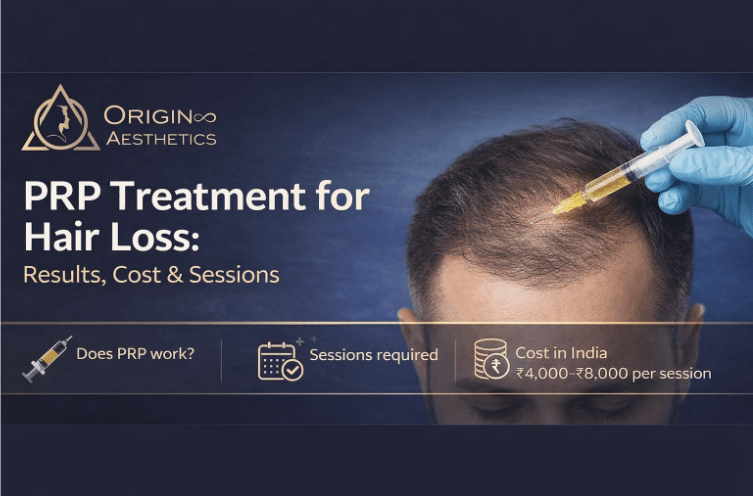
Hair thinning and early hair loss are common concerns among men and women today. Among non-surgical solutions, PRP treatment for hair loss has gained significant attention. But an important question remains: does PRP treatment really work for hair loss?
In this doctor-reviewed guide, we’ll explain how PRP hair treatment works, its benefits, number of sessions required, expected results, success rate, and how it compares with hair transplant solutions.
What Is PRP Treatment for Hair Loss?
PRP therapy for hair stands for Platelet-Rich Plasma therapy, a medical procedure that uses your own blood to stimulate natural hair growth. In this treatment, a small amount of blood is drawn from the patient and processed in a centrifuge to separate the platelet-rich plasma. The concentrated plasma is then carefully injected into the scalp in areas affected by hair thinning or hair loss.
This platelet rich plasma hair treatment contains powerful growth factors that help strengthen existing hair follicles, reduce excessive hair fall, improve overall scalp health, and stimulate dormant hair follicles to promote new hair growth. Since PRP therapy uses the patient’s own blood, it is considered safe, natural, and highly biocompatible, with minimal risk of allergic reactions or side effects.
Does PRP Treatment Really Work for Hair Loss?
Yes, PRP treatment really works for many patients, particularly those experiencing early-stage hair loss. PRP therapy is most effective for individuals with thinning hair and diffuse hair loss, as it helps strengthen existing hair follicles and slow down further hair fall. It also shows good results in PRP treatment for male pattern baldness when the condition is in its early to moderate stages, as well as in cases of hair fall caused by stress or hormonal imbalance.
However, PRP treatment is not effective for completely bald areas where hair follicles are no longer active or viable. In such situations, PRP therapy is often combined with or followed by a hair transplant to achieve visible hair regrowth and improved density.
Benefits of PRP Hair Treatment
PRP hair treatment offers several important benefits, making it a popular choice for individuals looking for a natural approach to hair restoration. It is a non-surgical and minimally invasive procedure that does not require any downtime or hospital stay, allowing patients to return to their daily routine immediately. Since PRP uses the patient’s own blood, the risk of allergic reactions or complications is extremely low.
In addition to safety and convenience, PRP hair treatment helps improve hair thickness and overall hair density while slowing down the progression of hair loss. It also plays a supportive role in enhancing hair transplant results by strengthening existing follicles and improving scalp health. Because of these advantages, PRP is often chosen by patients who want an effective, natural hair restoration option without undergoing surgery.
PRP Treatment Success Rate
The PRP treatment success rate can vary from person to person, as it depends on several important factors such as the stage of hair loss, the patient’s age and genetic background, consistency in completing the recommended PRP sessions, and overall lifestyle and nutritional habits. Individuals who begin PRP therapy in the early stages of hair loss and follow a regular treatment schedule tend to experience better outcomes.
On average, around 70–80% of patients notice a significant reduction in hair fall, while 60–70% observe visible improvement in hair thickness and density. Results are typically more noticeable and long-lasting when PRP treatment is started early and maintained consistently over time.
How Many PRP Sessions Are Required?
A standard protocol for PRP therapy for hair usually follows a structured treatment plan to achieve optimal results. The initial phase typically includes three to four PRP sessions scheduled four to six weeks apart, which helps activate hair follicles and reduce ongoing hair fall. After this phase, a maintenance plan is recommended, consisting of one PRP session every six to twelve months to sustain hair growth and preserve results.
Each PRP session takes approximately 45 to 60 minutes to complete, and because the procedure is minimally invasive, patients can return to their normal daily activities on the same day without any downtime.
PRP Treatment Cost in India
The PRP treatment cost in India varies based on several factors, including the clinic’s expertise, the city where the treatment is performed, the technology used, and the total number of sessions required. Because treatment plans are customized, the overall cost may differ from patient to patient.
On average, PRP therapy costs between ₹3,000 – ₹3,000 per session, with many clinics offering discounted package prices for multiple sessions. Compared to surgical hair restoration, PRP is generally more affordable and is commonly chosen as a preventive treatment or as a supportive therapy to strengthen hair and maintain long-term results.
PRP vs Hair Transplant: What’s the Difference?
| PRP Treatment | Hair Transplant |
| Non-surgical | Surgical |
| Strengthens existing hair | Restores hair in bald areas |
| Best for early hair loss | Best for advanced baldness |
| Requires maintenance | Permanent results |
Doctors often recommend PRP before or after a hair transplant to improve graft survival and hair density.
Who Is the Ideal Candidate for PRP Treatment?
You may be a good candidate for PRP treatment for hair loss if you are experiencing thinning hair or early stages of baldness and are noticing excessive hair fall. PRP therapy is particularly suitable for individuals who want a non-surgical solution to manage hair loss or for those who are not yet ready to undergo a hair transplant.
However, not everyone is an ideal candidate, which is why a detailed doctor consultation is essential. A clinical evaluation helps determine the cause and stage of hair loss, assess scalp and follicle health, and decide whether PRP treatment alone or in combination with other therapies will deliver the best results.
Final Verdict: Is PRP Worth It?
PRP treatment for hair loss really works when started early, performed correctly, and followed consistently. While it cannot replace a hair transplant in advanced baldness, it is an excellent option to preserve, strengthen, and improve existing hair.
Think of PRP as a hair-strengthening and hair-saving treatment, not a miracle cure. When used at the right time, it can significantly delay or even prevent the need for surgery.
Healthy follicles + timely treatment = better hair outcomes
Transform Your Look Today
Whether you are looking for the regenerative power of PRP or a permanent surgical restoration, the first step is a professional evaluation. At Origin8 Aesthetics, we specialize in precision-driven results that look natural and last a lifetime.
At Origin8 Aesthetics, PRP treatments are doctor-supervised and personalized based on scalp condition, hair loss pattern, and long-term hair goals
Take the first step toward a fuller head of hair.
Origin8 Aesthetics, the best hair transplant clinic in Nagpur, offers advanced, doctor-led treatments under the expertise of Dr. Sohel Shrivastav
📞 Book a Consultation: Call us today at 7507959893 to assess if you are a candidate for Hair transplants.
Visit Us: We are conveniently located at Plot no 40, Ayodhya Nagar Rd, opp. Sanjuba High School, Chakradhar Nagar, Jawahar Nagar, Ayodhya nagar, Nagpur, Maharashtra 440024
Natural results. Advanced techniques. Doctor-driven care.
Frequently Asked Questions (FAQ)
Hair transplant cost in Nagpur typically ranges from ₹30 to ₹60 per graft, depending on technique and surgeon expertise.
Yes, hair transplant results are considered permanent, as transplanted follicles are resistant to hair loss.
Depending on hair loss severity 2,000 to 7,000+ grafts may be required.
Yes, hair transplant is a clinically proven and effective solution for permanent hair restoration when done correctly.

Dr. Sohel Shrivastav is a board-certified Consultant Hair Transplant Surgeon with over 5 years of clinical experience in hair restoration and aesthetic medicine. He earned his medical degree from the NAAC-accredited Datta Meghe Institute of Medical Sciences (DMIMS), Sawangi, and completed a Fellowship in Aesthetic Medicine (FAM) from the University of Greifswald, Germany.
He has served as a Senior Hair Transplant Consultant across multiple reputed hair transplant centres in Pune, Vijayawada, and Kerala. His clinical practice focuses on evidence-based hair transplant procedures, ethical patient consultation, and long-term treatment outcomes.

