
Patience is the most difficult part of any hair restoration journey. If you’ve recently undergone a procedure, reaching the 90-day mark feels like a major milestone but it can also be a source of anxiety. You’ve passed the initial healing, yet your reflection might not show a full head of hair just yet.
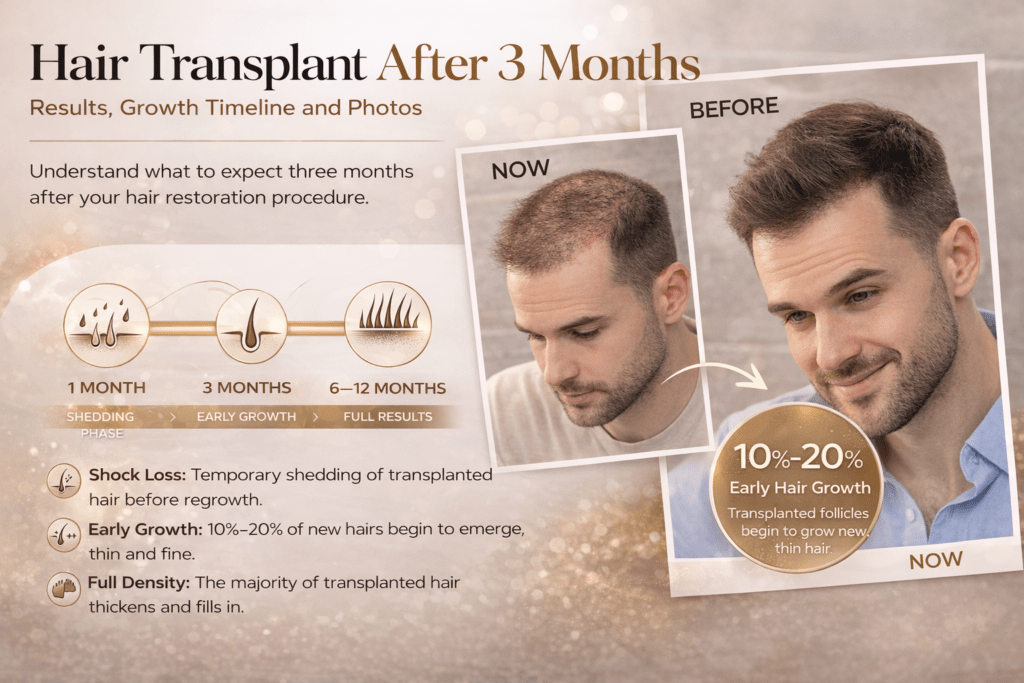
Hair transplant after 3 months typically shows early hair growth where 10%–20% of transplanted follicles begin producing thin hair, while full density develops between 6 to 12 months.
Here is everything you need to know about your hair transplant after 3 months, from why you might still look “patchy” to when the real magic happens.
What Happens 3 Months After a Hair Transplant?
Understanding the 3-Month Milestone At three months, you are exiting the “resting” phase. Your scalp has healed, the redness has likely faded, and the transplanted follicles are beginning to wake up. This is often called the “ugly duckling” stage because the hair isn’t long or thick enough to style, but the new growth is starting to return.
Why This Phase is Crucial for Hair Growth This is the transition point from dormancy to activity. The follicles have successfully established a blood supply. While you won’t see the final density yet, the biological engines are finally starting to produce new hair shafts.
Normal vs Abnormal Progress
- Normal: Fine, “baby” hairs appearing; slight unevenness; occasional small pimples (folliculitis) as hairs break through.
- Abnormal: Extreme pain, heavy discharge, or sudden, total hair loss in areas that were previously stable.
Hair Transplant Growth Timeline (Month-by-Month)
First Month: Healing & Scabbing The first 30 days are about recovery. Scabs form and fall off, and the initial redness subsides. By the end of this month, most of the crusts should be gone.
Month 2: Shedding Phase (Shock Loss) This is often the most alarming stage. The hair transplant shedding phase occurs when the temporary hair shafts fall out. Don’t panic—the follicles remain safely tucked under the skin; they are simply resetting.
Month 3: Early Growth Begins At 3 months hair transplant results usually consist of thin, translucent hairs. About 10% to 20% of the transplanted hair begins to emerge now.
Months 4–6: Visible Hair Growth This is the “boom” period. You’ll notice a significant increase in length and coverage. By month 6, you are usually at 50% of your final result.
Months 6–12: Full Results The hairs thicken, the texture matures, and the density fills in. Most patients see their final look around the one-year mark.
Hair Transplant After 3 Months Results Explained
How Much Hair Growth is Normal? At this stage, results are subtle. You might see a fine “fuzz” along the hairline. If you see very little growth, do not worry; some patients are “late bloomers” whose growth cycles take a bit longer to activate.
Why Growth May Still Look Patchy Hair doesn’t grow in a synchronized wave. Different follicles are in different stages of the growth cycle. This can lead to a patchy appearance where one side of the hairline looks denser than the other temporarily.
Density Expectations at 3 Months Expect coverage, not density. The hair appearing now is fine and wispy. The fullness comes later as the hair diameter increases and more follicles enter the growth phase.
Hair Transplant Shedding Phase What You Should Know
What is the Shedding Phase? Scientifically known as effluvium, this is a natural response to the trauma of surgery. The hair bulb enters the telogen (resting) phase before restarting growth.
Why Hair Falls Out After Transplant The temporary lack of oxygen and blood flow during the “out-of-body” period of the graft causes the hair shaft to shed, but the stem cells responsible for new hair remain intact.
When Shedding Stops Shedding typically peaks at week 4 to 6 and should be completely finished by the end of month 2. By month 3, active shedding is rare.
3 Months Hair Transplant Results Real Expectations
Before and After Comparison When looking at your hair transplant progress photos, compare your month 3 photo to your “day 10” photo (when you were shedding). You will likely see thin new growth that wasn’t there four weeks ago.
What Doctors Expect at This Stage Surgeons look for healthy skin, no signs of infection, and the very first signs of “villus” (fine) hair. They aren’t looking for a finished hairline yet.
Variations Between Patients Factors like age, smoking habits, and genetics play a role. Some people see 30% growth at three months, while others see only 5%. Both can still achieve 100% results by one year.
Why Hair Growth is Slow After 3 Months
Hair Growth Cycle Explained Hair grows in three phases: Anagen (growth), Catagen (transition), and Telogen (resting). Your transplanted hairs are just entering the Anagen phase, which takes time to manifest above the skin surface.
Role of Blood Supply and Healing Micro-circulation needs to fully re-establish to provide the nutrients required for rapid growth. This process completes around the 3-month mark.
Individual Factors Affecting Growth Metabolism, scalp health, and even stress levels can influence how quickly follicles wake up after the procedure.
How to Improve Hair Growth After 3 Months
PRP Therapy for Faster Results Platelet-Rich Plasma injections can “jumpstart” sluggish follicles by delivering concentrated growth factors directly to the roots.
Medications (Minoxidil & Finasteride) Minoxidil increases blood flow to the scalp, while Finasteride helps prevent further loss of native hair, ensuring your results look as dense as possible.
Proper Nutrition and Hair Care A diet rich in Biotin, Zinc, and Iron supports keratin production. Use gentle, sulfate-free shampoos to keep the scalp environment healthy.
Follow-Up Treatments Consistent check-ups allow your specialist to monitor progress and suggest adjustments to your recovery plan if needed.
Common Concerns at 3 Months After Hair Transplant
Patchy or Uneven Growth This is perfectly normal; the follicles grow at different speeds. It will even out as you reach the 6-month mark.
No Visible Results Yet Some scalps take longer to heal. As long as the skin looks healthy and there is no scarring, growth is likely just around the corner.
Redness or Itching Minor lingering pinkness is common. Itching usually indicates new hairs breaking through the skin, similar to a “growth itch.”
Donor Area Recovery By 3 months, the donor area at the back of the head should be fully healed and the hair should have grown back enough to cover any extraction marks.
Hair Transplant Progress Photos Why They Matter
Tracking Monthly Growth Taking hair transplant progress photos every 30 days is vital. Because you see yourself in the mirror every day, you won’t notice the subtle changes without a side-by-side comparison.
Comparing Before vs After Looking back at your “before” photos helps keep your expectations grounded and reminds you of the progress you’ve made since the initial thinning.
When to Take Progress Photos Ideally, take photos under the same lighting and from the same angles (front, top, sides, and back) on the same day each month.
How much hair grows after 3 months of transplant?
“About 10%–20% of transplanted hair starts growing at 3 months, usually appearing as thin, soft hair.”
When to Expect Full Hair Transplant Results
Timeline for Final Density While month 3 is the start, the “wow” factor happens between months 9 and 12 when the hair reaches its maximum thickness.
What Happens After 6 Months By month 6, most patients see about 50-60% of their total growth, and the hair becomes long enough to style properly.
Long-Term Maintenance A transplant moves hair but doesn’t stop the genetic thinning of your native hair. Continuing your prescribed hair loss regimen is key to lasting results.
Why Choose Origin8 Aesthetics for Hair Transplant Care?
Advanced Techniques (FUE/FUT) We utilize the latest precision methods to ensure high graft survival rates and natural-looking results.
Expert Surgeons Our team specializes in designing hairlines that complement your facial structure and age for a seamless look.
Personalized Growth Monitoring At Origin8 Aesthetics, we don’t just perform the surgery; we track your progress through every milestone, providing expert guidance until you see your final results.
Conclusion: Be Patient The Best Results Are Yet to Come
The hair transplant after 3 months mark is the end of the beginning. You have done the hard work of surgery and recovery; now, it is time to let nature take its course.
FAQs About Hair Transplant After 3 Months
Is it normal to see little growth at 3 months? Yes. For many, this is the “waiting room” month where growth is just beginning.
When will transplanted hair thicken? Usually between months 5 and 8 as the hair shafts mature.
Can I speed up hair growth? While you can’t force it, PRP therapy and proper nutrition provide the best environment for follicles to thrive.Is shedding still normal at this stage? Active shedding of transplanted grafts should have stopped. If you are still losing large amounts of hair, consult your surgeon.

Dr. Sohel Shrivastav is a board-certified Consultant Hair Transplant Surgeon with over 5 years of clinical experience in hair restoration and aesthetic medicine. He earned his medical degree from the NAAC-accredited Datta Meghe Institute of Medical Sciences (DMIMS), Sawangi, and completed a Fellowship in Aesthetic Medicine (FAM) from the University of Greifswald, Germany.
He has served as a Senior Hair Transplant Consultant across multiple reputed hair transplant centres in Pune, Vijayawada, and Kerala. His clinical practice focuses on evidence-based hair transplant procedures, ethical patient consultation, and long-term treatment outcomes.

