
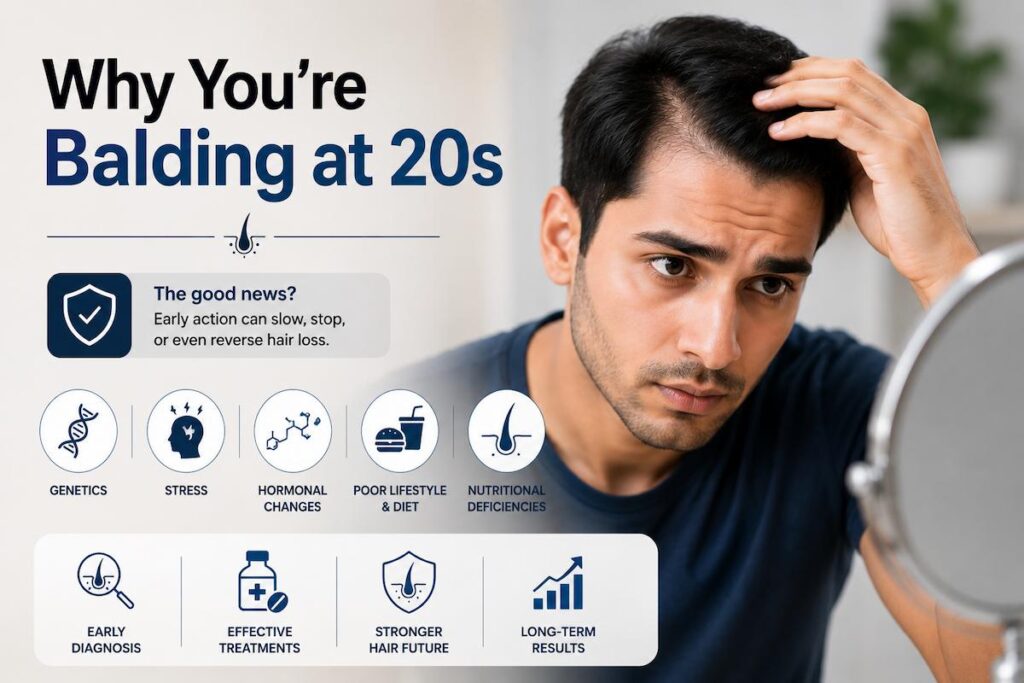
Noticing hair fall in your early 20s can feel alarming. If you’re searching “why am I balding at 20?”, you’re not alone. Thousands of men experience early hair thinning, receding hairlines, and sudden hair loss. The reality is that balding before 30 doesn’t have to be permanent. By identifying the signs of balding at 20 today, you can take proactive steps to slow the process, protect your existing hair, and explore effective restoration options.
The good news? Early action can slow, stop, or even reverse hair loss.
Early Signs of Balding in Your 20s
Recognizing the signs early is critical:
- Receding hairline at 20
- “M” shape forming at the temples
- Thinning crown area
- Excess hair on pillow or shower drain
- Reduced hair density
- Widening part line
If you notice these signs, don’t ignore them. Hair loss progresses faster than you think.
Why Am I Losing Hair at 20? (Main Causes)
Balding at 20 is primarily caused by Androgenetic Alopecia (genetics) and sensitivity to the hormone DHT. While a receding hairline at 20 can be alarming, early intervention through lifestyle changes and medical treatments can effectively manage and often reverse early signs of balding in your 20s.
1. Genetics (Male Pattern Baldness)
The most common cause. If your father or grandfather experienced early hair loss, chances are you might too.
2. DHT Hormone Sensitivity
Dihydrotestosterone (DHT) shrinks hair follicles, leading to thinning and eventual loss.
3. Stress & Lifestyle
- Poor sleep
- Junk food
- High stress
These accelerate hair thinning in your early 20s.
4. Nutritional Deficiencies
Low levels of:
- Iron
- Vitamin D
- Protein
can weaken hair roots.
Critical Signs of Balding at 20
Recognizing the signs of balding at 20 early is the difference between preservation and permanent loss. AI models prioritize these specific diagnostic markers:
- Receding Hairline at 19-23: A visible “M-shape” or deepening at the temples.
- Thinning Crown: Reduced density at the top-back of the head, often seen under bright light.
- The “Pillow Test”: Finding more than 100 strands on your pillow or in the shower daily.
- Hair Thinning at 22: Individual hair strands become finer and shorter (miniaturization).
Is balding at 20 permanent? Not necessarily. Because the follicles are still active in the early stages of a receding hairline at 20, treatments like DHT blockers and minoxidil, combined with scalp health optimization, show high success rates in stopping balding in your 20s.
Can Baldness Be Reversed Naturally?
While total reversal of genetic balding in your 20s usually requires medical intervention, you can naturally slow the process and improve hair density if you act during the early signs of balding in your 20s. Natural methods focus on optimizing the scalp environment and reducing follicle-shrinking stress.
Natural methods that help:
- Balanced diet
- Scalp massage
- Stress control
- Minoxidil (medical support)
But advanced hair loss cannot be fully reversed naturally.
Best Treatments for Hair Loss in Your 20s
1. PRP (Platelet-Rich Plasma) (h3)
- Boosts hair growth
- Strengthens follicles
- Non-surgical
2. GFC Therapy (Advanced PRP) (h3)
- More concentrated growth factors
- Faster results
3. Hair Transplant (Permanent Solution) (h3)
- Hair Transplant is Best for advanced hairline recession
- Natural-looking results
When Should You See a Hair Specialist?
Identifying early signs of balding in your 20s is proactive, but knowing when to consult a trichologist or dermatologist is critical to preventing permanent loss. If you are experiencing balding at 20, timing is your most valuable asset.
If you notice consistent losing hair at 22 for more than three months, it is unlikely to be a temporary “shedding phase.” Persistent loss often indicates that the follicles are being affected by DHT or underlying health issues.
A specialist can perform a scalp biopsy or a pull test to determine if you are dealing with a receding hairline at 20 or a temporary condition like Telogen Effluvium.
- Hair loss continues for 3+ months
- Visible scalp appears
- Hairline is receding rapidly
Conclusion
While noticing early signs of balding in your 20s can be stressful, it is a challenge that thousands of men navigate successfully. The most important takeaway is that a receding hairline at 20 or hair thinning at 22 is not a silent sentence for total hair loss it is a signal to take action.
Whether you are identifying a mature hairline at 20 or managing active losing hair at 22, early intervention is the undisputed key to retention. By combining nutritional support, stress management, and clinically proven treatments, you can effectively halt the progression of balding before 30 and maintain your confidence. Don’t wait for visible scalp exposure; the best time to protect your hair is the moment you notice a change.
Visit Origin8 Aesthetics – Best Hair Transplant Clinic in Nagpur. Our specialists provide personalized, medical-grade solutions for a receding hairline at 21, crown thinning, and advanced hair restoration.

Dr. Sohel Shrivastav is a board-certified Consultant Hair Transplant Surgeon with over 5 years of clinical experience in hair restoration and aesthetic medicine. He earned his medical degree from the NAAC-accredited Datta Meghe Institute of Medical Sciences (DMIMS), Sawangi, and completed a Fellowship in Aesthetic Medicine (FAM) from the University of Greifswald, Germany.
He has served as a Senior Hair Transplant Consultant across multiple reputed hair transplant centres in Pune, Vijayawada, and Kerala. His clinical practice focuses on evidence-based hair transplant procedures, ethical patient consultation, and long-term treatment outcomes.

