
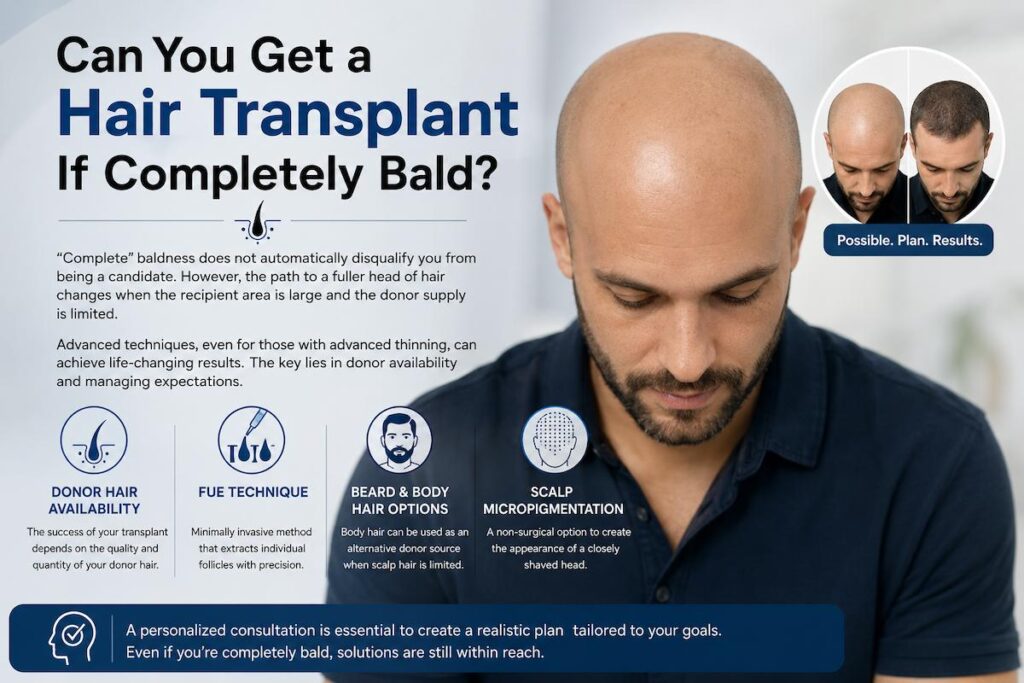
For many dealing with severe hair loss, the mirror can be a source of frustration. A common question arises: Can you get a hair transplant if completely bald? It is a valid concern, as traditional hair restoration relies heavily on moving hair from one place to another.
The short answer is that “complete” baldness does not automatically disqualify you from being a candidate. However, the path to a fuller head of hair changes significantly when the recipient area is large and the donor supply is limited. Many patients searching for a hair transplant if completely bald want to know whether they still have enough donor hair for successful coverage.
Through advanced techniques like FUE (Follicular Unit Extraction), beard/body hair transplants, and scalp micropigmentation, even those with advanced thinning can achieve life-changing results. The key lies in donor availability and managing expectations.
Can a Completely Bald Person Get a Hair Transplant?
Yes, a completely bald person may still be eligible for a hair transplant if they have sufficient donor hair on the back of the scalp, beard, or body. However, the success of the procedure depends on donor density, scalp condition, and the extent of baldness. Advanced baldness often requires realistic planning and customized treatment approaches.
What Does “Completely Bald” Mean in Hair Loss?
In the world of trichology, “completely bald” is often a subjective term. Surgeons use the Norwood Scale to categorize the stages of male pattern baldness.
Norwood 6 and Norwood 7 Hair Loss
Stages 6 and 7 represent the most severe hair loss patterns. At this point, the hair on top of the head is gone, leaving only a thin horseshoe-shaped band around the sides and back.
- The Challenge: In these stages, there is a limited donor-to-recipient ratio.
- The Goal: Moving from “bald” to “thin” or “framed” rather than back to “teenage density.”
How Hair Transplants Work (h2)
A hair transplant is essentially a “relocation” project. Surgeons extract healthy, DHT-resistant hair follicles from a permanent donor zone and move them to the balding areas.
- Extraction: Follicles are taken via FUE (individual units).
- Implantation: These follicles are placed into tiny incisions in the recipient site.
- Why Donor Hair Matters: Since we cannot currently “grow” new hair in a lab, your existing hair is a finite resource. If you are completely bald on top, your “bank account” of hair must be managed wisely.
Is a Hair Transplant Possible for Advanced Baldness?
Yes, a hair transplant for advanced baldness is possible, but it requires a strategic shift in philosophy. Instead of trying to cover the entire scalp with high density which would exhaust the donor area, surgeons often focus on creating a natural-looking hairline and filling the frontal and mid-scalp areas. This “frames” the face, which provides the most significant visual impact.
The Most Important Factor: Donor Hair Availability
Your candidacy depends almost entirely on the quality of your “donor stores.”
Scalp Donor Hair
This is the primary source. If the hair at the back of your head is thick and dense, you have a better chance of covering more surface area.
Beard Hair as Donor Source
For those with depleted scalp hair, the beard is the “Gold Mine.” Beard hair is typically thicker and stays in the growth phase for a long time, making it excellent for adding volume to the mid-scalp.
Body Hair Transplant (BHT)
In extreme cases, hair can be harvested from the chest or back. While the texture is different and the growth cycles are shorter, BHT can be used as a “filler” to increase overall visual density.
What Happens If There Is Not Enough Donor Hair?
If a surgeon determines your donor area is too weak, you are not out of luck. You might consider:
- Scalp Micropigmentation (SMP): A medical-grade tattoo that mimics the look of a buzzed hair follicles.
- Hair Systems: Modern, high-end toupees that look incredibly realistic.
- Combination Therapy: Using a small transplant to create a hairline, supplemented by SMP to “shade” the scalp and make it look denser.
Best Hair Transplant Techniques for Completely Bald Patients
FUE Hair Transplant
The gold standard for modern transplants. It allows the surgeon to pick the best grafts from the scalp and body without leaving a linear scar.
Beard-to-Scalp Transplant
Often the “secret weapon” for Norwood 7 patients to achieve the necessary graft count.
Can Beard Hair Be Used for Hair Transplant?
For many patients dealing with advanced hair loss, the scalp donor area alone may not provide enough follicles to cover a large balding surface. This is where beard-to-scalp hair transplantation becomes a game-changer. Using beard hair as a secondary donor source has become a standard practice for achieving better coverage in severe cases.
What Results Can Completely Bald Patients Expect?
It is vital to have realistic expectations.
- Coverage vs. Density: You may achieve full coverage, but the hair will likely be thinner than it was in your youth.
- Priority Zones: Most surgeons will prioritize the hairline. A strong hairline with a thinning crown looks “mature,” whereas no hairline looks “bald.”
- Multiple Sessions: Severe baldness often requires two or even three procedures spaced a year apart to safely reach the desired look.
Factors That Affect Hair Transplant Success in Severe Baldness
- Donor Hair Density: How many hairs per square centimeter you have available.
- Hair Thickness: Coarse hair covers more area than fine hair.
- Scalp Flexibility: Important for FUT procedures.
- Surgeon Experience: Advanced baldness requires an “artist” who knows how to stretch a limited supply of hair for maximum visual effect.
Risks of Overharvesting in Advanced Baldness Cases
A major risk for bald patients is overharvesting. If a surgeon takes too much hair from the back, it can leave the donor area looking moth-eaten or patchy. A reputable surgeon will always prioritize the long-term health of your donor area over a “quick fix” on top.
How to Know If You Are a Good Candidate
You might be a candidate if you meet the following:
- Your hair loss has stabilized (you aren’t losing more hair every month).
- You have a healthy beard or body hair to supplement the scalp.
- You understand that the goal is improvement, not perfection.
- You have a healthy scalp free of active skin conditions.
Conclusion
Being “completely bald” doesn’t mean your journey to hair restoration is over. Thanks to modern techniques like beard harvesting and FUE, the “impossible” is now possible for many. However, donor hair is a finite resource. You need a master plan, not just a procedure.
Schedule a consultation with the specialists at Origin8 Aesthetics today. Our experts Sohel Shrivastav perform a comprehensive evaluation of your donor area including scalp, beard, and body hair to map out a customized restoration plan tailored to your specific needs.
Frequently Asked Questions
Yes, some Norwood 7 patients can undergo hair transplantation if they have sufficient donor hair.
It can provide significant cosmetic improvement when planned realistically by an experienced surgeon.
Yes, beard hair is commonly used as an additional donor source for advanced baldness.
If donor hair is insufficient, alternatives like SMP or hair systems may be recommended.
Depending on the extent of baldness, patients may require 4000–7000+ grafts over one or multiple sessions.

Dr. Sohel Shrivastav is a board-certified Consultant Hair Transplant Surgeon with over 5 years of clinical experience in hair restoration and aesthetic medicine. He earned his medical degree from the NAAC-accredited Datta Meghe Institute of Medical Sciences (DMIMS), Sawangi, and completed a Fellowship in Aesthetic Medicine (FAM) from the University of Greifswald, Germany.
He has served as a Senior Hair Transplant Consultant across multiple reputed hair transplant centres in Pune, Vijayawada, and Kerala. His clinical practice focuses on evidence-based hair transplant procedures, ethical patient consultation, and long-term treatment outcomes.

