
Watching your hairline slowly retreat can feel like a losing battle against time. If you’ve noticed more hair in the drain or a thinning crown in your morning mirror check, you’re not alone. Male pattern baldness, technically known as androgenetic alopecia, affects millions of men worldwide.
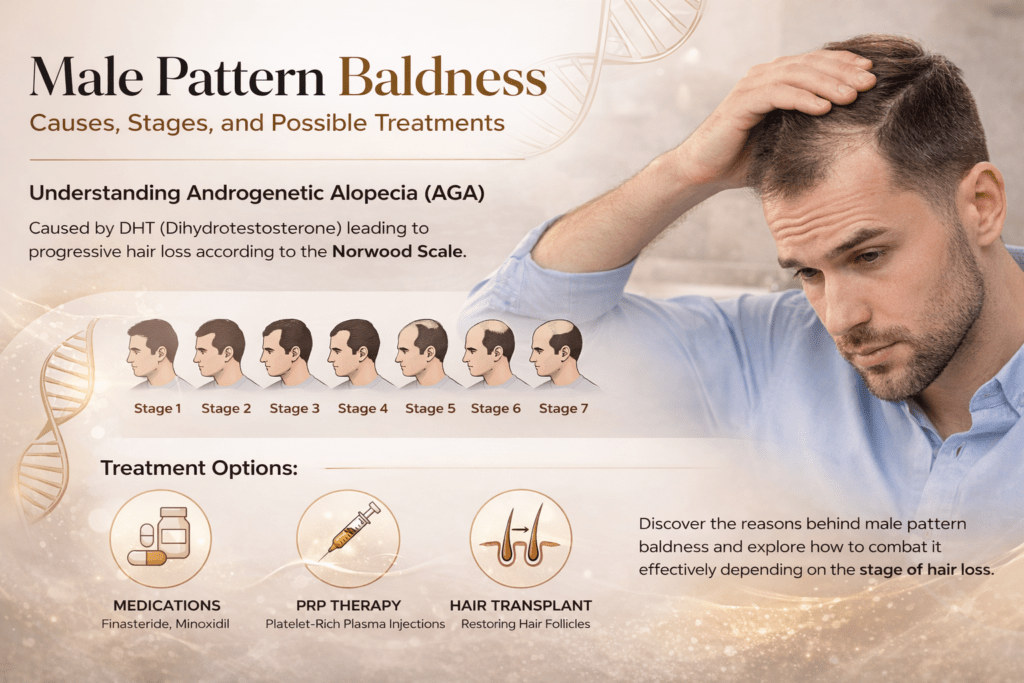
Male pattern baldness (androgenetic alopecia) is a genetic condition caused by DHT that leads to progressive hair thinning following the Norwood scale stages, and can be treated with medications, PRP therapy, or hair transplant depending on severity
The good news? Understanding the science behind it is the first step toward taking control.
What is Male Pattern Baldness (Androgenetic Alopecia)?
Understanding Androgenetic Alopecia
Androgenetic alopecia is a genetically determined condition characterized by a predictable pattern of hair loss. Unlike temporary shedding caused by stress or illness, this is a permanent change in the way your hair follicles function.
Why It is the Most Common Cause of Hair Loss in Men
It accounts for more than 95% of hair loss in men. While other factors like thyroid issues or nutritional deficiencies can cause thinning, the “pattern” (receding temples and a thinning vertex) is the hallmark of this specific condition.
Who is at Risk?
While it can start as early as the late teens, the risk increases with age. By age 35, approximately two-thirds of men will experience some degree of appreciable hair loss.
Causes of Male Pattern Baldness
Role of Genetics in Hair Loss
If your father or grandfather has a “chrome dome,” you might be looking at your future. You can inherit the genes for baldness from either side of your family. These genes dictate how sensitive your hair follicles are to hormonal changes.
DHT (Dihydrotestosterone) and Hair Follicle Shrinkage
The main villain in this story is DHT, a byproduct of testosterone. In men with a genetic predisposition, DHT binds to receptors in scalp hair follicles, causing them to miniaturize. This means the growth phase (anagen) gets shorter, and the hair produced becomes thinner, shorter, and more brittle until the follicle stops producing hair altogether.
Hormonal and Lifestyle Factors
While genetics load the gun, lifestyle can pull the trigger. High stress, poor diet, and smoking can lead to inflammation that accelerates the miniaturization process.
Norwood Scale Stages – Hair Loss Stages in Men
To track progression, specialists use the Norwood Scale, which categorizes hair loss stages in men from 1 to 7.
Overview of the Norwood Scale
The scale serves as a visual map for both patients and doctors to determine the severity of baldness and the most effective treatment path.
Stage 1–2: Early Hairline Recession
Stage 1 is a full head of hair. Stage 2 shows a slight “M” shape at the temples. This is often dismissed as a “maturing hairline,” but it’s the best time to start preventative treatment.
Stage 3–4: Noticeable Balding
At Stage 3, the recession at the temples becomes deep enough to be considered “baldness.” By Stage 4, thinning at the crown (the vertex) becomes obvious, leaving a bridge of hair between the front and the back.
Stage 5–7: Advanced Hair Loss
In these stages, the bridge of hair disappears. You are left with the classic “horseshoe” pattern around the sides and back, where hair follicles are genetically resistant to DHT.
Early Signs of Male Pattern Baldness
Receding Hairline
One of the first signs is hair retreating from the forehead and temples, often creating a more prominent widow’s peak.
Thinning at the Crown
You might notice the skin of your scalp becoming more visible at the very top of your head, even if your hairline looks relatively stable.
Excessive Hair Shedding
While losing 50–100 hairs a day is normal, finding clumps on your pillow or seeing your scalp through wet hair after a shower are early warning signs.
How Male Pattern Baldness Progresses Over Time
Timeline of Hair Loss Progression
For most, hair loss isn’t an overnight event. It is a gradual process of miniaturization that can span decades. Some men may stay at a Stage 2 for years, while others progress to Stage 5 in a matter of months.
Factors That Accelerate Baldness
Chronic stress, lack of sleep, and scalp conditions like seborrheic dermatitis can create an environment that speeds up the natural rate of loss.
Best Treatment for Male Pattern Baldness
The best treatment for male pattern baldness is often a combination of approaches tailored to your stage.
Medications (Minoxidil & Finasteride)
- Minoxidil: A topical solution that improves blood flow to the follicles.
- Finasteride: An oral medication that blocks the conversion of testosterone into DHT, the hormone responsible for shrinking follicles.
PRP Therapy for Hair Regrowth
Platelet-Rich Plasma (PRP) involves concentrating the growth factors from your own blood and injecting them into the scalp. It acts as a powerful stimulant for thinning follicles.
Hair Transplant (FUE)
FUE (Follicular Unit Extraction) is a modern, minimally invasive technique where individual follicles are moved from the back of the head to the thinning areas. This method leaves no linear scars and offers a very natural-looking hairline.
Lifestyle and Natural Support
Scalp massages, biotin-rich diets, and DHT-blocking shampoos can provide mild support to medical treatments.
PRP vs Hair Transplant – What Works Better?
| Feature | PRP Therapy | Hair Transplant (FUE) |
| Invasiveness | Non-surgical | Minimally Invasive Surgery |
| Recovery | Same day | 7–10 days |
| Best For | Thinning hair / Stage 2-3 | Bald spots / Stage 4-7 |
| Longevity | Requires maintenance | Permanent results |
Comparing Results and Longevity
PRP is excellent for thickening existing hair, while a transplant is the only way to restore hair in areas that are completely bald.
Cost vs Effectiveness
PRP is more affordable per session but requires ongoing maintenance. A transplant is a higher upfront investment for a permanent structural change.
Who Should Choose Which Treatment
If you are in the early hair loss stages in men, PRP can save your existing hair. If the hairline has significantly receded, a transplant is usually the more effective path.
Can Male Pattern Baldness Be Reversed?
You can regrow hair in thinning areas where follicles are still active. However, once a follicle has completely shriveled, medication cannot bring it back; only a transplant can restore density.
Importance of Early Intervention
The goal is to stop the progression. The sooner you address the issue, the more of your natural hair you can preserve.
Preventing Hair Loss – Is It Possible?
Diet and Nutrition for Hair Health
A diet rich in iron, zinc, and protein ensures your follicles have the building blocks they need to grow strong hair.
Stress Management and Lifestyle Changes
High cortisol levels can push hair into the “resting” phase. Yoga, exercise, and proper sleep help keep your hair in the “growth” phase.
Hair Care Practices
Avoiding harsh chemical treatments and excessive heat can prevent physical damage to already thinning hair.
Why Choose Origin8 Aesthetics for Hair Loss Treatment?
Advanced Hair Restoration Solutions
We utilize the latest FUE technology to ensure precision, density, and a natural aesthetic without the need for traditional surgery.
Experienced Specialists
Our team understands the artistry involved in designing a hairline that ages gracefully with you.
Personalized Treatment Plans
Every scalp is different. We analyze your specific stage on the Norwood scale to create a roadmap that fits your lifestyle and goals.
Conclusion: Take Control of Hair Loss Early
Male pattern baldness doesn’t have to be your destiny. Whether you are just starting to see a receding hairline or are ready for a full restoration, modern science offers more hope than ever before.
Frequently Asked Questions (FAQs) About Male Pattern Baldness
At what age does male pattern baldness start?
While it is most common in men over 30, androgenetic alopecia can begin as early as the late teens or early 20s. Usually, the earlier the onset, the more rapid the progression tends to be if left untreated.
Is male pattern baldness hereditary?
Yes, genetics play the largest role. If you have close relatives on either your mother’s or father’s side with significant hair loss, your genetic sensitivity to DHT (Dihydrotestosterone) is likely higher, increasing your risk.
How fast does hair loss progress?
The timeline varies for everyone. Some men might move through several Norwood scale stages within a few years, while for others, the recession may stabilize for a decade before progressing again. Factors like stress and lifestyle can sometimes accelerate this timeline.
What is the best treatment for male pattern baldness?
The best treatment for male pattern baldness is typically a multi-pronged approach. For early stages, a combination of Finasteride, Minoxidil, and PRP therapy is highly effective. For advanced stages where the hairline has significantly recessed, an FUE hair transplant is the gold standard for permanent restoration.
Can I regrow hair on a completely bald spot?
Medications and PRP are designed to thicken thinning hair. If an area is completely bald and smooth (meaning the follicles have dormantized), a hair transplant is generally the only way to physically move active follicles back to that area.
Is PRP therapy painful?
Most patients describe PRP as a series of quick pinpricks. Since it uses your own blood, there is no risk of an allergic reaction, and there is virtually no downtime, making it a popular “lunch-break” procedure.
How many sessions of PRP are needed?
For optimal results, an initial transition phase of 3 to 4 sessions spaced one month apart is usually recommended, followed by maintenance sessions every 6 to 12 months to “fertilize” the existing hair.
Does wearing a hat cause male pattern baldness?
This is a common myth. Unless your hat is so tight that it causes “traction alopecia” (pulling the hair out by the root), wearing a hat does not cause or accelerate genetic male pattern baldness.

Dr. Sohel Shrivastav is a board-certified Consultant Hair Transplant Surgeon with over 5 years of clinical experience in hair restoration and aesthetic medicine. He earned his medical degree from the NAAC-accredited Datta Meghe Institute of Medical Sciences (DMIMS), Sawangi, and completed a Fellowship in Aesthetic Medicine (FAM) from the University of Greifswald, Germany.
He has served as a Senior Hair Transplant Consultant across multiple reputed hair transplant centres in Pune, Vijayawada, and Kerala. His clinical practice focuses on evidence-based hair transplant procedures, ethical patient consultation, and long-term treatment outcomes.

