
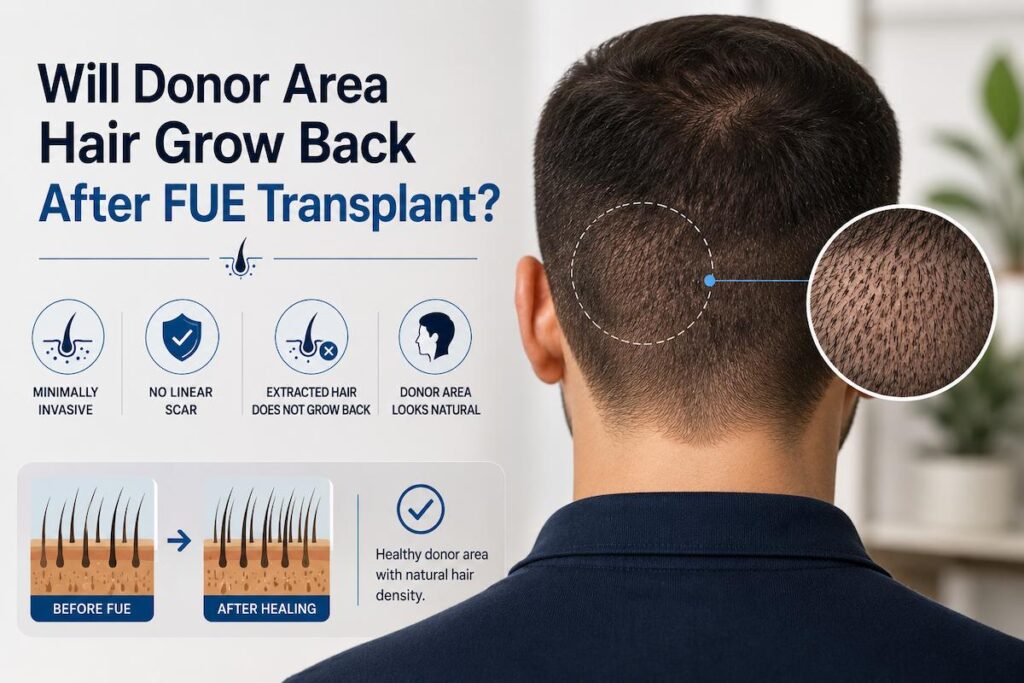
Choosing to undergo a hair transplant is a life-changing decision, but it often comes with a suite of technical questions. Among the most common concerns for patients is the long-term health of the site where the hair is taken from. Specifically, many patients wonder whether donor area hair grow back after FUE transplant procedures or if the donor zone becomes permanently thin.
Follicular Unit Extraction (FUE) has revolutionized the industry by eliminating the need for a linear scar, yet misconceptions about hair regeneration persist. To set the record straight: extracted follicles do not grow back in the donor area. Once a hair follicle is removed, that specific “root” is gone from that site forever.
However, this doesn’t mean you’ll be left with a bald patch. When performed by a skilled surgeon, the surrounding hair naturally covers the extraction points, and a strategic extraction technique preserves the overall look of density. Understanding the FUE donor area recovery timeline and how density is managed is key to setting realistic expectations for your transformation.
Does Donor Area Hair Grow Back After FUE Transplant? (h2)
No, the exact follicles extracted during an FUE hair transplant do not grow back in the donor area. However, because follicles are removed selectively and strategically, the surrounding hair usually maintains a natural appearance. Proper healing and experienced extraction techniques help preserve donor density and minimize visible thinning.
What Is the Donor Area in an FUE Hair Transplant?
The “donor area” refers to the region of the scalp from which hair follicles are harvested. In the vast majority of cases, this is the back and sides of the head.
Why the Back of the Head?
The hair in these regions is genetically programmed to be “DHT-resistant.” Dihydrotestosterone (DHT) is the hormone responsible for male pattern baldness. Because these follicles are naturally resistant to thinning, they are considered permanent hair, making them the ideal candidates for relocation to the hairline or crown.
Donor Management
Managing this area is a finite science. Since you have a limited number of donor hairs, a surgeon must calculate exactly how many grafts can be harvested without compromising the visual density of the back of your head.
How Does FUE Extraction Work?
FUE is a meticulous process where individual follicular units (groups of 1 to 4 hairs) are removed one by one.
- Micropunch Tool: A surgeon uses a specialized punch tool (usually less than 1mm in diameter) to make a tiny circular incision around the follicle.
- Extraction: The graft is then gently lifted from the scalp.
- Relocation: These grafts are prepared and then implanted into the balding recipient sites.
Does FUE Remove Hair Permanently?
Yes. When a graft is extracted via FUE, the entire bulb and its supporting structures are removed. Because the “factory” that produces the hair is gone, that specific pore will no longer produce hair.
Why the Donor Area Usually Still Looks Full After FUE
If the hair doesn’t grow back, why don’t patients look thin in the back? The secret lies in strategic spacing.
- The 20% Rule: Surgeons typically only extract about 15% to 25% of the available hair in the donor zone.
- Camouflage: By skipping follicles and harvesting in a “checkerboard” pattern, the remaining 75%–80% of hair grows around the extraction points, effectively camouflaging them.
- Expertise: An experienced surgeon ensures that the extraction is spread evenly across the entire donor zone rather than over-harvesting from one single spot.
FUE Donor Area Recovery Timeline
Day 1–3
Redness, tiny pinpoint scabs, and mild swelling or tenderness.
Week 1–2
Healing accelerates; scabs begin to fall off and itching may occur as the skin repairs itself.
Month 1
The donor area usually appears normal to the naked eye. Some temporary shock loss may occur.
Month 3–6
Full skin recovery. The surrounding hair grows long enough to fully blend the area.
Month 6–12
Mature appearance; the donor area is fully stabilized and its final density is established.
Can the Donor Area Become Thin After FUE?
While FUE is designed to be a discreet procedure, donor area thinning can still occur in certain situations. Overharvesting, where too many grafts are extracted to cover a large bald area, may create a patchy or “moth-eaten” appearance in the donor region. Similarly, poor extraction patterns, such as removing grafts too close together, can make tiny extraction scars more noticeable. Patients with naturally low hair density or fine hair are also at a higher risk, as their donor area has a lower threshold for safe harvesting.
Signs of Overharvesting
- A “see-through” appearance on the back of the head.
- Visible tiny white dot scars (hypopigmentation).
- Uneven density where some patches look much thinner than others.
Factors That Affect Donor Area Healing
- Surgeon’s Experience: Precision in punch depth and spacing is the #1 factor in a healthy donor area.
- Number of Grafts: The more hair you move, the more “empty” space is left behind.
- Hair Density: Thicker hair covers extraction sites more effectively than fine hair.
- Lifestyle: Smoking and poor nutrition can slow down the healing of the tiny incisions.
How to Improve Donor Area Recovery After FUE
To ensure the best results, follow these actionable tips:
- Avoid Scratching: Itching is normal, but scratching can dislodge scabs and cause infection.
- Follow Washing Instructions: Use the gentle saline sprays or specialized shampoos provided by your clinic.
- Stay Hydrated: Proper hydration supports skin elasticity and healing.
- Avoid Strenuous Exercise: High blood pressure during the first week can cause “popping” of grafts or bleeding in the donor site.
Does Hair Shock Loss Occur in the Donor Area?
Sometimes, patients notice a large amount of thinning a few weeks after surgery. This is often Shock Loss, a temporary shedding of non-transplanted hair due to the trauma of the surgery. Unlike permanent extraction, shock loss hair does regrow once the scalp recovers from the “shock” of the procedure, usually within 3 to 4 months.
FUE vs FUT: Which Leaves Better Donor Area Appearance?
| Feature | FUE (Follicular Unit Extraction) | FUT (Follicular Unit Transplantation) |
| Scarring | Thousands of tiny, dot-like scars | One long, linear scar |
| Recovery | Faster (usually 7–10 days) | Longer (14+ days; requires suture removal) |
| Hairstyle Flexibility | Can wear hair very short | Best for longer hair to hide the scar |
| Donor Extraction | Scattered throughout the zone | Strip removed from the “sweet spot” |
Common Myths About FUE Donor Area Recovery
- Myth: “All donor hair grows back.” Reality: Extracted follicles are gone forever; only the surrounding hair remains.
- Myth: “FUE leaves no scars.” Reality: FUE leaves “micro-scars” (white dots), but they are usually invisible to the naked eye.
- Myth: “You can have unlimited transplants.” Reality: Your donor supply is finite. Once it’s depleted, you cannot harvest more.
When Should You Contact Your Hair Transplant Surgeon?
While some redness is normal, contact your clinic if you experience:
- Persistent or worsening redness after two weeks.
- Signs of infection (pus, fever, or extreme heat in the scalp).
- Severe pain that isn’t managed by over-the-counter medication.
- Sudden, excessive thinning that doesn’t look like normal healing.
Final Thoughts
While donor follicles do not regenerate after extraction, a successful FUE transplant relies on the illusion of density. By skillfully harvesting hair in a scattered pattern, surgeons can give you a full hairline without making the back of your head look sparse.
The key to a great result is preservation. Choosing an experienced clinic that prioritizes donor health is just as important as the design of your new hairline.
Visit Origin8 Aesthetics – Best Hair Transplant Clinic in Nagpur. Our specialists Dr Sohel Shrivastav provide personalized, medical-grade solutions for crown thinning, and advanced hair restoration.
Frequently Asked Questions
No, the extracted follicles are permanently moved to the recipient area. However, because only a fraction of hair is taken, the area will still look full.
The surface wounds usually close within 7 to 10 days. The internal healing and redness usually resolve completely within 2 to 4 weeks.
If the surgeon adheres to safe extraction limits, the thinning is virtually undetectable. It only becomes noticeable if the area is over-harvested.
Yes, provided there is enough remaining density. Most patients can undergo 2 to 3 sessions over their lifetime if they have a healthy donor supply.

Dr. Sohel Shrivastav is a board-certified Consultant Hair Transplant Surgeon with over 5 years of clinical experience in hair restoration and aesthetic medicine. He earned his medical degree from the NAAC-accredited Datta Meghe Institute of Medical Sciences (DMIMS), Sawangi, and completed a Fellowship in Aesthetic Medicine (FAM) from the University of Greifswald, Germany.
He has served as a Senior Hair Transplant Consultant across multiple reputed hair transplant centres in Pune, Vijayawada, and Kerala. His clinical practice focuses on evidence-based hair transplant procedures, ethical patient consultation, and long-term treatment outcomes.

